
Edition 5 October 2026
Calendar
| Date | Description |
|---|---|
| Mon 10/12/26 6 PM | City Council, Council Chambers. During General Public Remarks, presentation of Safe Parking Program letter. Flock cameras item 9 |
| Sat 10/17/26 12N-1PM | Mori Point, HWY 1, NO KINGS protest. See Coastside United calendar for other events. |
| Mon 10/19/26 7 PM | Planning Commission, Council Chambers |
| Tue 10/20/26 9 AM | San Mateo County Board of Supervisors, 500 County Center, Redwood City. Presentation of letter of support of Pacifica Safe Parking Program. |
| Tue 10/20/26 6:30-8PM | Coastside United General Meeting, Little Brown Church |
| Wed 10/21/26 5 PM-7PM | Rockaway Ricky 2027 Calendar Release Party, Rockaway Beach Brewery |
| Mon 10/26/26 6 PM | City Council, Council Chambers |
| Sat 11/07/26 10 AM | Arbor Day Celebration and Tree Planting, Pacifica Center for the Arts, 1220 Linda mar Blvd. Must register to plant a tree. See post. |
| Sun 11/08/26 2 PM | 50TH celebration of the Pacifica Historical Society, Pacifica Coastside Museum, 1850 francisco |
| Mon 11/09/26 6 PM | City Council, Council Chambers |
| Tue 11/17/26 6:30-8 PM | General Meeting, Coastside United, Little Brown Church |
| Mon 11/23/26 6 PM | City Council, Council Chambers |
See posted calendars for:
-
Mildred B. Owen Concert Hall
-
Pacifica Libraries
-
Coastside United
Photos have been contributed by Leo Leon
Pacifica Voice is eager to receive articles on issues important to our community. Please send them to editors@pacvoice.org for consideration.
To receive press releases and periodic messages from the Pacifica Voice please add your name and email address to our subscriber list – SUBSCRIBE HERE. FREE
CLOSE TO HOME
Community Alert
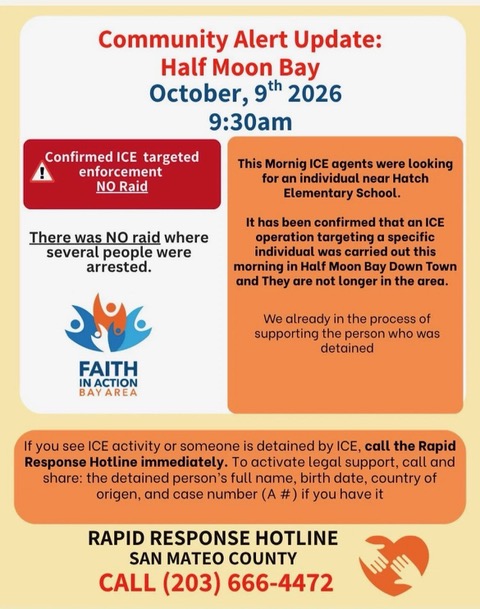
Rapid Response Hotline
If immigration comes to your home, work or neighborhood, or if there is ICE activity nearby, call the San Mateo County Rapid Response Hotline at 203-666-4472 (203-NO-MIGRA).
Si inmigración viene a su casa, trabajo o vecindario, o si hay actividad de ICE cerca, llame a la línea de respuesta rápida del Condado de San Mateo al 203-666-4472 (203-NO-MIGRA).
How Can You Protect and Prepare Your Family and Yourself from Immigration Enforcement Activity?
San Mateo County offers a variety of downloadable tools designed for diverse audiences, including community-based organizations and county residents directly affected by immigration concerns who are seeking clear answers.
Things That Can Help Right Now
- Rapid Response Hotline: In case of ICE contact or sightings, call the San Mateo County Rapid Response Hotline at (203) 666-4472 / (203) NO-MIGRA. The hotline is open 24/7; save this number to your phone. The County funds Faith in Action to provide this service. Download Rapid Response posters and cards: Chinese (simplified) poster / card, English poster / card, Portuguese poster / card, Spanish poster / card, Tagalog poster / card, Tongan poster / card.
- Know Your Rights: Keep the red card handy at all times. If you come across ICE, remember that you have constitutional rights. Learn more and download the red card. Available in Chinese (simplified), English, Portuguese, Russian, Samoan, Spanish, Tagalog, Tongan.
- Immigrant Registration Requirement: Have questions about the Immigrant Registration Requirement that went into effect on April 11, 2025? Read the Frequently Asked Questions.
- Preparedness Plans: Have a plan for you and your family in case someone is detained. Find plan templates here.
- Know Your Rights Fact Sheets: for various situations: at the border or airports, in police custody or jail, in public spaces, in your car, in your home, at work, in removal proceedings, or in immigration detention. Available in English, Spanish and Chinese. Find the flyers here.
- Legal Services: Contact an immigration attorney about your legal options before speaking or signing anything. Find a local, nonprofit legal services organization.
- Find an ICE Detainee: To find someone currently in ICE custody, or who has been in U.S. Customs and Border Protection custody for more than 48 hours, search by A-number or biographical information.
More Resources
For more resources, including mental health resources, pathways to citizenship and public charge information, visit the County’s Immigrant Services page.
For California state information and resources, including immigration-related guidance from the California Attorney General to help individuals, businesses and public entities understand and respond to new immigration laws, see the Attorney General’s publications.
Thank You for Supporting Safe Parking for Unhoused Residents of the Coast
From Faith in Action Bay Area and Pacifica Housing 4 All
Join us at the Pacifica City Council on Monday, October 12, at 6:00 PM and the San Mateo County Board of Supervisors on Tuesday, October 20, at 9:00 AM.
Letter in Support of Coastside Safe Parking
Dear San Mateo County Board of Supervisors and Pacifica City Council,
We the undersigned support the extension and expansion of the Safe Parking Program (SPP), currently limited to Pacifica, further down the Coastside to Pescadero. This extension will provide safe, environmentally sound temporary housing for individuals and families living in RVs while simultaneously assisting these families into permanent housing. The program provides dignity, safety, and a continuum of care.
The SPP has been successful. Thirty-eight percent of the participants have moved into permanent housing, a much higher percentage than similar programs.
Even more important than the program’s success is our moral obligation to assist the most vulnerable of our community members. Homelessness on the Coast impacts the wellbeing of the entire Coastal Community: the economy, the environment, neighborhood streets, and the social fabric of the Coast.
Housing is a critical need for families with children, the elderly, the working poor and the disabled in Pacifica and throughout the Coastside. Affordable housing is scarce and there is only one shelter available, Coasthouse, with a two-month waiting list. Other homeless resources on the Coast are also limited as compared to the Bayside. As a result, some individuals and families choose an RV as a last resort.
RV dwellers experience unsheltered homelessness, with a lack of other options available. Combined, Pacifica and the unincorporated Coastside comprised nearly a third of the unsheltered population identified by the San Mateo County Homeless Count of 2026.
Unhoused individuals and families parking on neighborhood streets are vulnerable to harassment and vandalism. The Safe Parking Program provides dignity, safety, and relief with real solutions:
- Wraparound social services that include medical and mental health care and assistance with the transition into suitable long-term housing
- Vehicle repair and rental subsidy for an RV park
- Trash and grey/black water disposal, which mitigates environmental impact
We urgently request the extension and expansion of the Safe Parking Program before funding lapses at the end of October.
We hope you can join us as we read our letter to our elected officials and deliver public comment in support of Safe Parking for unhoused neighbors at the following meetings:
- Pacifica City Council: Monday, October 12, 2026, at 6:00 PM. Zoom link and details.
- San Mateo County Board of Supervisors: Tuesday, October 20, 2026, at 9:00 AM. Meeting details.
Please join us to share written or verbal support for Safe Parking at either meeting. We expect that support for the Pacifica Resource Center (the organization that oversees the Safe Parking Program) will be on the meeting agendas. Remarks are limited to 3 minutes at the Pacifica City Council and 1 minute at the Board of Supervisors. Talking points can be found within the letter and below.
Please also continue to share the letter with neighbors and organizations, so more people can sign on to help our unhoused neighbors have a place to sleep with dignity and safety.
Additional Talking Points for Public Comment
1. Top causes of homelessness are poverty and a lack of affordable housing.
- The Coast has among the highest rents in the County, in addition to low vacancy rates.
- Low-income workers, including agricultural workers, merchant support, childcare and elder care workers, cannot afford the rents.
- Wages have not kept up with housing costs.
2. The Coastside desperately needs this program.
- The 2026 Homeless Count showed the highest number of homeless residents are in Pacifica and along the Coast.
- The Homeless Outreach Team has identified families with children, the working poor, elders and people with disabilities living in motorhomes.
- Coastal shelter and Safe Parking are limited to the Coast House, which has a two-month waiting list, and the 15 spaces in Pacifica’s Safe Parking Program (expiring in October).
- Coastal transportation is less than robust, forcing low-income workers to find lodging close to employment.
- The first-ever San Mateo County Homeless Mortality Report suggests that chronic homelessness can reduce lifespan by 20–30 years.
3. The Safe Parking Program has proven successful.
- A higher success rate than similar programs, with 38% permanently housed.
- 131 individuals from 77 families received services.
- 40 individuals from 23 families returned to housing.
- 23 motor homes are no longer on Pacifica streets.
- Successfully took RVs off neighborhood streets.
- Mitigated environmental impact with trash and grey water pickup.
- Provided wraparound services that addressed individual barriers to housing.
- Ending the program could force participants back onto neighborhood streets and stop grey water and trash pickup.
4. We urgently need safe temporary housing options as a pathway to permanent housing.
- Until safe and affordable housing is available for all, temporary programs are needed as a pathway to permanent housing. Currently the safe parking program has 14 families with 21 participants with 2 families on the waitlist.
- Studies on best practices for reducing homelessness point to the need to build a relationship of trust and an individualized housing plan.
- Thank you, Supervisors and Pacifica Council Members, for your leadership to end homelessness on the Coast.
Donate to Support Families at Risk of Homelessness
Belong Fund for Emergency Support and Basic Income
We are low-income immigrant families who arrived in the Bay Area seeking refuge from violence and fear. Most of us have been or are still homeless because the rents are so high. We want to work, but the federal government is making it more and more difficult for us to get work permits—and even when we have them, employers sometimes reject us for being recent immigrants. We want our kids to have a better future, but economic life in this wealthy city is very challenging for us.
The Belong Fund provides emergency support and basic income for low-income community members like us who are at risk of deportation, homelessness or displacement.
Fund for Families Impacted by Detention of a Breadwinner
Over 80 of our neighbors in San Mateo County have experienced one of our worst fears as immigrants: the detention of a family member. When it happens, we not only have to deal with the trauma of family separation, but also the immediate economic impact of losing a breadwinner, while at the same time trying to find tens of thousands of dollars to pay for a lawyer so our loved one can get due process. You can read about one of our stories in this article in The Guardian, published last Christmas.
The Fund for Families Impacted by Detention of a Breadwinner provides families with rent and groceries for three months following a detention.
Measure Q and 555 Kelly
By Joanne Rokosky
The proposed farmworker housing at 555 Kelly in Half Moon Bay has been fought since the project was originally proposed by Mercy Housing and ALAS (Ayudando Latinos A Soñar). In 2022, the City of Half Moon Bay released a Request for Qualifications (RFQ) for projects related to affordable housing, and the joint proposal by Mercy Housing and ALAS was the only applicant. Their project called for development of a 4-story complex to provide 40 studio homes for farmworkers age 55 or older. In response to requests from the farmworkers for one-bedroom units instead of studios, the design was revised to include a 5th story, which is set back from the front of the building and adds 5 feet to the original project height. The design includes 18 resident parking spaces and a community resource center on the ground floor.
Since its inception, the farmworker community has vocally supported this project at multiple community meetings and has been joined by housing advocates and members of Coastside Faith in Action. Equally vocal have been the opponents, citing concerns about the building’s height, impact on parking and traffic in the vicinity, potential overcrowding, and objections to the design. There have also been thinly veiled concerns about the dangers of having elderly farmworkers living close to nearby schools. Mercy Housing has responded to these challenges with numerous revisions to the design. Ultimately, the project was approved by the Coastal Commission, the Planning Commission and the Half Moon Bay City Council.
Nevertheless, opponents continued their objections through a signature-gathering effort for a ballot referendum to overturn the final approval by the Half Moon Bay City Council. This effort was presented as giving voters a choice rather than as direct opposition to 555 Kelly, and sufficient signatures were obtained to place a referendum on the November ballot.
If approved by voters, this referendum, Measure Q, allows development of the project to proceed. If opposed, as advocated by the opponents of 555 Kelly, development of this affordable housing for farmworkers will be halted. Complicating the issue is the fact that the City of Half Moon Bay still does not have an approved Housing Element, and the 555 Kelly project is closely tied to several other projects within the Element. Hence, delays could lengthen the time before the Housing Element gains final approval and increase the risk of lawsuits and fines by the State.
A volunteer effort in support of 555 Kelly and a vote in favor of Measure Q is underway, with support from housing advocates including Coastside Faith in Action and Faith in Action Bay Area. Their website has more information and answers to frequently asked questions. The City of Half Moon Bay has also established a Measure Q website.
No Kings

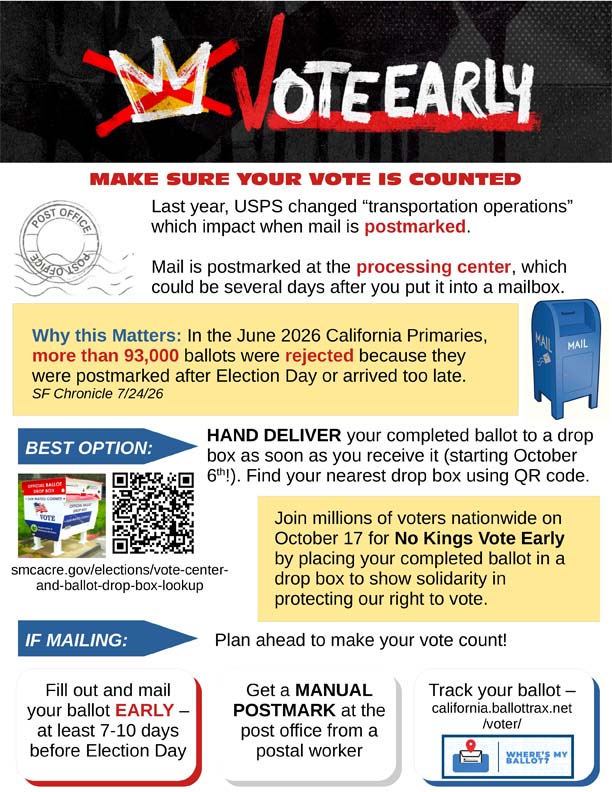
October 17 No Kings: Vote Early
October 17 is a day of nonpartisan voter participation. We are bringing our community together to make a plan to vote early, and to make sure every eligible voter understands their options for how to vote and has the opportunity to make their voice heard. Vote early, or join us and make a plan to vote!
Pacifica: 12:00–1:30 PM
Hwy 1 & the Moose Lodge. Meet at the entry to Mori Point. In addition to signs promoting voting, Refuse Fascism signs will be available to remind us why we are voting! Get your Refuse Fascism signs at the northwest corner of Hwy 1 and Reina Del Mar, and gather along the roadway north of the stoplight.
Half Moon Bay: 10:30 AM–Noon
Hwy 1 and Miramontes Point Road. It’s Pumpkin Festival weekend: come to the rally, then enjoy the festival afterwards.
San Francisco: 11:00 AM–12:30 PM
Human Banner, “No Kings: Vote Early!” at Ocean Beach Stairwell 17, 1000 Great Hwy, San Francisco.
Colma: 2:00–3:30 PM
Corners of Serramonte Blvd and Junipero Serra. We will have extra signs and look forward to celebrating voting with you.
Bring a Sign
Register or just come, and bring a friend! Bring Vote Early signs or props, or other nonpartisan signs promoting voting. Some ideas:
- Your Vote = Your Voice!
- Speak Up. Vote!
- Make a Plan to Vote!
- Vote Early with Your Friends!
- Get Out the Vote!
- You Have Choices. Vote!
- Prevent Truth Decay. Vote!
- Voting Is an American Right!
- Fair and Free Elections
- Check Your Registration
- Vote Early
Find all events and register at mobilize.us/nokings.


In My Opinion (IMO)
Introducing IMO
Jack Coots, Pacifica Voice Editor
An IMO section of The Voice would be appropriate. There are obviously some big issues that everyone does not agree on but certainly deserve our platform serving as a stimulus for discussion. Those discussions are needed more than ever as the Progressive Movement works through growing pains and proselytizing messaging.
We Can Prevent Mass Surveillance: Flock Cameras
By Liz van Zyl and Lorrie Sheets
In 2024, Pacifica contracted with Flock Safety for its automated license plate reader (ALPR) system. Since then, Pacifica locals and visitors alike have been surveilled as they go about their days, many without realizing it. The Pacifica City Council has until its November 9, 2026, meeting to decide whether to renew the current contract with Flock Safety. If the Council takes no action, the contract will automatically renew. Before that happens, let’s look at the capabilities of these “license plate readers.”
For every vehicle image captured, the ALPR system records the date and time, location, make, model, color, dents, bumper stickers and modifications. This information is stored and searchable for thirty days. After processing the images, the system checks whether the license plate matches one on the police department’s “hot list” and alerts police when there is a match.
Most police departments in California have a contract for an ALPR system and can share information with other departments. By law, ALPR data can only be shared within California. Presently, the Pacifica Police Department has chosen to share only within the Bay Area.
As technology progresses, so do the capabilities of ALPR devices. Newer ALPRs can record audio as well as trace signals coming from electronics. Drone use is also becoming common in Bay Area police departments.
Gathering data about an individual’s movements, friends, habits, devices and even pets produces a troubling amount of detail and specificity that is difficult to justify collecting under any circumstances. Over 99% of the data collected is never used by police.
The stated reason for acquiring the Flock system is to enhance community safety. However, the Flock system is sold and maintained by a private company without data regulation. These days, data is a valuable commodity, and Flock holds gigabytes of searchable data from throughout the United States. It amounts to mass surveillance.
Why Should You Be Worried If You Haven’t Done Anything Wrong?
- ALPR systems make mistakes. While ALPR companies claim 93%–97% accuracy in reading license plates, mistakes have led to frightening encounters between innocent people and police. Mistakes also create financial risk for police departments because they open them to lawsuits.
A woman in San Francisco was stopped by police because the ALPR system indicated she was driving a stolen car. Multiple officers ordered her at gunpoint to exit the car and kneel on the ground, and then handcuffed her. It took 20 minutes for officers to realize they had made a mistake and release her. - Flock has lied to customers. One Flock representative told a City Council that Flock software could not create a map of individuals’ movements (a “heat map”). The Police Chief was then shown by his staff that the representative had lied. The Chief informed the City Council, and the Council withdrew its contract approval the next day.
In another incident, Flock was forced to admit to a “pilot program” it conducted from May through August 2025 with the Department of Homeland Security that allowed ICE to use individual customers’ data without their knowledge or permission. When this was discovered, all Flock said was that it had “communicated poorly.” - ALPR systems violate our constitutional right to privacy and subject people to warrantless searches and mass surveillance. ALPRs do not distinguish between individuals who are under investigation or of interest; instead, they capture the details of everyone who passes by.
Even behavior or movements that are perfectly legal or unremarkable can become a premise to monitor, track and build a case against an individual in the future. It seems that every week we wake to another senseless abduction or murder by ICE agents. But we are not powerless in the face of this; these abductions are in part due to the precision with which persons of interest can be tracked. That’s why we must never stop resisting attempts to mass surveil our community. The Pacifica City Council has a duty to protect our neighbors and those who visit our town by canceling all ALPR contracts and standing with our neighbors for a safer community for everyone.
Urge your City Council member to keep us safe from unconstitutional stalking by private companies. Make a sign and come to the next City Council meeting to share how you feel about being surveilled without cause.
We are all stronger together! Email stopALPRpacifica@protonmail.com to get in touch with our coalition of grassroots activists.
Flock Pacifica: Staff Report, Grand Jury Response
Make Your Voice Heard on Flock Cameras
- Speak in person: Pacifica City Council, Monday, October 12, 6:00 PM, Council Chambers, 2212 Beach Blvd. Flock is on the agenda as Item 9 (Consideration). Fill out a speaker card for Item 9 and speak when it comes up (usually up to 3 minutes).
- Send a written comment: Email publiccomment@pacifica.gov by noon on the meeting day. Include your full name, and in the subject line put “October 12, 2026 – Item 9.”
- Keep it up: The Council meets again on October 26 and November 9, the deadline to decide on renewing the Flock contract. Check the meeting calendar for agendas, which are posted 72 hours before each meeting.
Tip: Name the issue in your first sentence, share how it affects you personally, and close with what you’re asking the Council to do.
The Moral Dilemma of a Sales Tax
By Pete Shoemaker
Pacifica has a 1% sales tax measure on the November ballot, and many people are morally against all sales taxes, saying that they disproportionately hurt low-income residents. This vote will have major consequences for our City, so rather than debate the pros or cons, I’d like to offer a framework—a point of view—that could help people determine what truly is the right thing to do.
Every medicine on the market has negative side effects for some portion of the population. Any medicine is on the market because these negative effects are very small compared to the overall benefits to the greater population. As a society we accept that nothing will be 100% perfect, and we have a principle of “greater good” to guide us. If we had a “zero tolerance” policy and rejected medicines with any negative effects, we would have few if any medicines, and many people, including most cancer survivors, would not be here.
The sales tax could have strong negative side effects, so to speak, for a certain portion of our population. The failure of the tax measure, and the resulting cutbacks in City services, could have negative effects on the entire population, including the people who visit and all other living species here. I encourage you to look at this overall picture, get the facts needed to properly assess these effects, and choose what would be the “greater good”—although in this case you might phrase it as “lesser harm.” Either way, the goal is the best medicine.
Support Our Schools. Support Our Kids.
by Erin Gale
In conversations across Pacifica, I’ve found that most people share a common goal: they want to support our children and see our schools succeed. Concerns about the district’s financial management and leadership deserve to be heard. Families and taxpayers are right to expect responsible financial decisions, transparency, and accountability from our school district.
But Measure T is not a new tax. It is a renewal of existing local funding that supports programs our students already depend on, including fifth-grade Outdoor Education, library services, and mental health counseling. If Measure T fails, Pacifica schools will face an additional $1.3 million in cuts.
We can support accountability and responsible leadership while protecting the programs that help our children thrive. Losing this funding would leave our schools with fewer resources and greater challenges. We cannot expect schools to do more with less and maintain the programs and services our students need.
Measure T includes safeguards such as a citizens’ oversight committee and annual audits to help ensure these dedicated funds are used responsibly. Supporting the measure and expecting accountability go hand in hand.
Pacifica schools already operate with fewer resources than many neighboring districts. Our teachers, librarians, counselors, and classified staff work hard every day to support our students. We need to retain these dedicated local educators, not lose them to neighboring districts that can offer better pay. These are members of our community who invest in our children, building relationships that help students feel connected, supported, and ready to learn. We cannot afford to lose more of the people who make our schools special.
Libraries build literacy and reading comprehension. Counselors help students navigate challenges. Outdoor Education gives fifth graders opportunities to learn beyond the classroom. These programs offer more than academic benefits; they create opportunities for children to discover new interests, build confidence, and form lasting memories. They are essential parts of a well-rounded education that every student deserves.
At a time when our schools face significant financial challenges, we have an opportunity to come together around what matters most: our kids. Voting Yes on Measure T helps preserve the programs and people that make our schools special. Let’s support our schools and support our kids.

HOUSING
A Home for All: Why Redwood City Should Vote Yes on Measure E
By Amanda Chang – Urban Habitat & San Mateo Anti-Displacement Coalition
Housing is the foundation everyone deserves—a stable and dignified place to raise a family, grow old, and belong to a community. In Redwood City, where fully half the residents are renters, that foundation is cracking: average rents have increased 47% since 2010, and two out of three low-income families are now paying more than half their income just to keep a roof over their heads.
This affordability crisis impacts us all, but the burden is not shared evenly: Latino renters are the most rent burdened, and Redwood City lost 54% of its lower-income Black households between 2010 and 2019, double the displacement of lower-income white households.
City Hall wasn’t fixing the problem in Redwood City, so residents did something about it. Tenants, seniors, and neighbors worked together over several years to craft Measure E and gather the signatures to put it on November’s ballot—and the San Mateo Anti-Displacement Coalition, a coalition of local organizations working to prevent displacement, is proud to endorse it.
Other Bay Area cities have faced this exact crisis—and made real progress. Alameda has seen a 46.8% reduction in homelessness due to both its growing portfolio of affordable rental homes and the city’s rent program, which recovered $500,000 for tenants in 2025 due to invalid rent increases. Mountain View’s rent stabilization program cut no-fault evictions from 86 a year to just 6. These aren’t fringe experiments — they’re common sense, tested policies that keep working families housed without upending the local housing market.
Measure E will give voters the opportunity to repair the cracks to our vital foundation.
Although Redwood City has made strides to address the crisis by building new affordable housing, it still lacks the tenant protections we need to keep families in their homes.
Measure E – the Redwood City Fair and Affordable Housing Ordinance – closes the gap with three balanced tools: rent control, just cause for eviction, and tenant anti-harassment protections.
These protections are designed to be fair to everyone. Rent control will limit annual rent increases to 5% or 60% of the rate of inflation, whichever is less, keeping thousands of our neighbors in their homes while guaranteeing landlords still receive a fair return on their investment. Just cause for eviction protections ensure that our neighbors don’t lose their homes for arbitrary or discriminatory reasons. Tenant anti-harassment protections prohibit landlords from intimidating their tenants, failing to make repairs or other forms of mistreatment to push renters out of their homes—the kind of bad actor behavior that gives responsible landlords a bad name.
If the measure passes, the rent control protections would cover a quarter of the city’s residents, approximately 22,235 people, and the just cause and anti-harassment protections would cover half of the city’s residents, approximately 40,000 people. That means fewer abrupt moves and more of the stability that keeps families together and allows children to continue their education without disruption.
Think about who actually benefits. Teachers, nurses, and city workers could afford to live in the city they serve instead of commuting long distances from wherever rent is still low. That’s good for schools, good for emergency response times, good for local businesses that depend on a stable customer base; it’s good for everyone, the whole city, not just renters.
Redwood City needs both new affordable housing and strong tenant protections. These are complementary and necessary strategies. We don’t have to guess if this approach works; Alameda and Mountain View show us that it does.
Vote yes on Measure E — let’s make sure Redwood City lives up to our shared values of dignity and fairness to keep all of our neighbors stably housed.
Amanda Chang is the Program Director of Equitable Development at Urban Habitat, which convenes the San Mateo Anti-Displacement Coalition. Born and raised in San Mateo County, Amanda received their J.D. from Berkeley Law School.
HIP Housing

Homesharing – The Home Sharing Program matches people with rooms or accessory dwelling units (ADUs) for rent (Home Providers) with a Home Seeker who is looking for a reasonable room rental and/or exchanging extra household chores for reduced rent. All clients are interviewed and screened and provided a resource guide that includes questions potential housemates should review when they meet each other. HIP Housing also assists Home Sharers with completing a Living Together Agreement and provides ongoing follow-up support. Call (650) 348-6660 or visit our inquiry form home-sharing-program

CLIMATE AND ENVIRONMENT
In Honor of Jackie Eagle
By Stasha Powell
Jackie was an internet-famous bald eagle who lived near Big Bear Lake in California. Her life was shared with millions around the world through the Friends of Big Bear Valley live nest cam. In July 2026, after a territorial fight with younger eagles, Jackie was found on the ground, weak. The Ojai Raptor Center rescued and cared for her, but in spite of their efforts, she passed away in August 2026. She left a huge legacy in wildlife conservation and touched millions of hearts.
For those who say they don’t want Jackie to go to the National Eagle Repository, I want to offer a different way of looking at this. I first learned about the Repository from an Indigenous friend decades ago. I was fascinated, so I did what I do when something fascinates me: I went down the rabbit hole and researched it. (Learn about the National Eagle Repository.)
I think it is important to understand that the laws preventing Jackie’s remains from staying where they are also protect living bald and golden eagles. These two things are closely connected. (Read about the Migratory Bird Treaty Act.)
The rules about eagle bodies, feathers and remains help make sure that people cannot just kill an eagle or take parts from one they find. Some people have said, “They are just going to take Jackie’s feathers and cremate the rest.” That is not true. The National Eagle Repository distributes whole eagles, as well as wings, tails, heads, talons and feathers.
I have been privileged to attend Indigenous ceremonies where I saw an entire eagle wing used. I have seen an eagle head incorporated into a ceremonial staff. If you have ever been to a powwow and watched what happens when an eagle feather falls from someone’s regalia, you have gotten at least a glimpse of how sacred these feathers are and how seriously they are treated. Jackie is not going somewhere her body will become meaningless; quite the opposite.
Her remains will be given to Indigenous peoples, for whom eagles have deep religious and cultural meaning. Parts of Jackie may be used in ceremonies or become part of regalia. They may be cared for and honored for generations. I find that very beautiful.
I truly wish Indigenous studies were taught in every public school. Seeing the conversations about Jackie, I am surprised by how many people love these birds, spend years watching them, and know their nests and habits, but still know little about the laws that protect them or the long relationship Indigenous peoples have had with them.
I have loved bald eagles since I was a kid. I grew up on the Mississippi River, where they came every winter to the locks and dams. My grandfather and I would go watch them every year. Seeing them never stopped feeling miraculous.
I also spent time doing wildlife rehabilitation with large birds. In all that work, I had the opportunity to work with an eagle only once. But once is enough to understand that being close to one is an entirely different experience from watching one through binoculars or on a screen. They are extraordinary animals.
Years later, I lived in Moreno Valley in Southern California, about an hour and a half from Big Bear Lake. I visited Big Bear long before Jackie was even born. It was the first place I ever saw bald eagles in California; the only other place I saw them in the state was Lake Tahoe. So no, I never got to see Jackie herself when I was there. Somehow this feels like part of a much longer circle for me.
I understand why people who love Jackie feel protective of her body. Truly, I do. But I do not see the Repository as an indignity waiting for her. I see the possibility of one final act of reverence. Jackie spent her life making people look up, so much so that a philanthropic campaign raised $10 million to buy and permanently preserve 63 acres of the land that served as vital hunting and foraging ground for Jackie and still serves the eagles there. I love the thought that, after she is gone, she may remain sacred.
Bring Whale Alerts to West Coast Mariners
From the office of Congressman Sam Liccardo
WASHINGTON, D.C., October 9, 2026 – Bay Area Congressman Sam Liccardo (CA-16) has led a bipartisan effort to use technology to protect whales on the West Coast. His recent letter to the U.S. Coast Guard, the Federal Communications Commission and the National Oceanic and Atmospheric Administration requests an expansion of Automatic Identification System (AIS) messaging technology to send whale-safety information directly to mariners along the West Coast.
“With at least 145 gray whale collisions already reported along the West Coast in 2026, we must do more to keep both whales and mariners safe,” said Liccardo. “By implementing AIS whale-safety messages, we can give real-time warnings to mariners and help them avoid deadly collisions, without disrupting maritime activities.”
Liccardo and his cosigners ask the agencies to identify areas where AIS messaging could support voluntary speed reduction messages, determine whether existing whale detection programs can transmit information directly to mariners through AIS, and identify ways to streamline approval timelines while maintaining navigation and spectrum safeguards.
On the East Coast, federal agencies and regional partners already use AIS messaging to send location-specific alerts to vessels in whale speed reduction zones. Expanding AIS whale-safety messaging to the West Coast would use technology already familiar to mariners to provide additional information about whale activity.
“Expanding this capability is particularly relevant along the West Coast, where vessel traffic and whale activity increasingly overlap,” the lawmakers wrote.
The effort builds on Liccardo’s Save Willy Act, which would establish a “Whale Desk” at the Coast Guard’s San Francisco station to centralize whale sightings and alert vessel operators when whales enter the Bay.
“Using AIS technology to identify high-risk areas and alert mariners in real time can help prevent deadly vessel collisions with whales off California while keeping vital maritime traffic moving safely,” said Geoff Shester, Director of Fishery Innovation and Senior Scientist at Oceana. “This proven technology would give agencies and ship operators a practical, science-based tool to protect whales and improve safety in our busy coastal waters for all who use them.”
“Vessel strikes are a leading cause of death and serious injury for large whales and can result in substantial property damage for mariners, as well as pose a significant safety risk to those on board. IFAW has worked tirelessly to reduce the threat of vessel strikes and strongly supports the use of AIS as a warning system for mariners. We’re grateful to Representatives Liccardo, Case, Krishnamoorthi, Min, Moylan and Pallone for championing the use of AIS to improve mariner safety and help reduce the risk of vessel strikes on whales along the West Coast,” said Kathleen Collins, Senior Marine Campaign Manager at the International Fund for Animal Welfare.
Congressmembers Ed Case (HI-01), Raja Krishnamoorthi (IL-08), Dave Min (CA-47), Frank Pallone (NJ-06) and James Moylan (Guam) also signed the letter.
CELEBRATE ARBOR DAY, 11/7/26 AT 10 AM
By Paul Totah
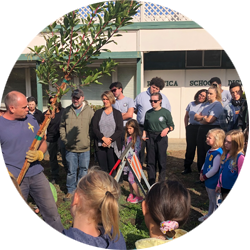
Pacificans will celebrate the city’s Eighth Arbor Day on November 7th, 10 AM, Sanchez Fields, at the Pacifica Center for the Arts,1220 Linda Mar Boulevard. We will plant 20 trees!!!
The community event, organized by the City of Pacifica and Tree City Pacifica, will include speeches by the mayor and other city dignitaries. We will also demonstrate how to successfully plant trees. Community volunteers will plant and stake trees and participate in the city’s effort for a verdant, sustainable Pacifica..
If you or your family would like to volunteer, send an email to treecitypacifica@gmail.com. Only registered volunteers will be able to plant a tree, but everyone is welcome to come and celebrate.
During the week preceding Arbor Day, trees will be planted at many Pacifica schools which gives students the opportunity to learn the value trees play in fighting climate change and promoting biodiversity. In this way, we help the city reach its goal of increasing the urban tree canopy to 25 percent.
The Arbor Day celebrations also include an art contest. Pacifica School District students were asked to illustrate the importance of trees in their lives and in the community. Winning entries will be displayed from November 6 through 15 at Sanchez Art Center (located at the Pacifica Center for the Arts, the site of the Arbor Day celebration).
Tree City Pacifica earns credits toward a Tree City USA status with each Arbor Day celebration. To learn more, go to facebook.com/treecitypacifica or send an email to treecitypacifica@gmail.com.
Tree Company Red Flags
By Paul Totah
You have most likely heard that the coming El Niño may bring strong winds to California this winter. Some of you with trees around your property may be worried about the damage fallen trees or branches might do to your home. We also know that some of you may be tempted to remove these trees. We at Tree City Pacifica have some advice and some red flags to increase your knowledge on tree removal services.
First, be aware of the value of your trees.
- Trees can add thousands of dollars in value to your property.
- Consider this website’s list of values: Trees absorb stormwater, reduce energy costs, improve air quality, and absorb carbon dioxide (helping you fight climate change right at home.)
- Trees also provide food and habitat for wildlife.
If you are going to hire someone to prune or remove a tree, consider the following:
- Use this website to find the right company to do the job. Search for an ISA-Certified Arborist. (This certification means they passed an exam demonstrating they understand tree biology, mechanics, proper pruning, and job safety.)
- If you want the risk of your tree assessed, look for arborists who hold additional qualifications – like the Tree Risk Assessment Qualification (TRAQ).
- Hire a separate tree trimming service after you receive advice from an arborist.
- Ensure the service has a license to do business in Pacifica via Pacifica BusinessLicense

THE COMMUNITY
Pacifica Resource Center Highlights

Thank You for Supporting Palm-a-Palooza 2026
Our Palm-a-Palooza Homecoming brought the community together for a night to remember. Together, we raised more than $120,000, with more still coming in, making this our biggest Palm-a-Palooza ever. Every one of those dollars helps Pacifica Resource Center keep our neighbors across Pacifica and the San Mateo County coast housed, fed and supported. We are deeply grateful to everyone who made it possible.
Booster Club Sponsors: Recology of the Coast, San Mateo County Association of Realtors, Tannura Family Wines, Myriam & Joel Fontaine, Anonymous
Pep Rally Sponsors: Anita M. Rees & Don Budetti, Bleyle Elevator San Francisco, Debbie & Curt Kiest, Eureka Square Chiropractic, Ginny & John Janes, HOPE: Healing, Overdose Prevention & Education, Karen & Mike Ervin, Mizpah Fellowship, Nancy Oaks, the Nibbelin Family, Pacifica Lions Club, Peter Loeb, Tom & Linda Jonas, Westlight Energy
Cheer Squad Sponsors: Anonymous (x2), Bill Michaelis & Dinah Verby, Blue Murov & Julie Starobin, Chris & Ron Gabrielli, Daniel Kumler & Charlotte Neff, Eccleston Incorporated, Illene Colby, Ina & Clarence Eaglin, Kathy Long & Greg Hirsch, Lois Marshall-Ward & Jerry Ward, Lori & Julius Yap, Marcia Settel, Michael Malone & Nancy Vargas, Monterra Credit Union, Nick’s Rockaway, Rick & Jane Nahass, Road Kill Cafe Fund, Sherman Lee & Claire Ervin Lee, Suzanne Moore & Robert Holland, The Sam Mazza Foundation, Tri Counties Bank, The Ulmer Family
Mascot Sponsors: Cindy Abbott, Renee Batti & Lionel Emde
Auction, Pick-a-Prize & In-Kind Donors: Elizabeth Bredall, Half Moon Bay Brewing Company, Humble Sea Brewing Pacifica, Lagunitas Brewing Co., MS Studio, Six Sigma Ranch & Winery, Cal Athletics, Berkeley Repertory Theatre, Touch Holistic Day Spa, Fairfield Inn & Suites San Francisco Pacifica, Ocean Yoga & Massage, 650 Fitness, Little Leaf Design, San Mateo County Supervisor Ray Mueller, Debbie & Roger Reynolds, San Jose Earthquakes, San Francisco Giants, Yomi & Mimi Agunbiade, Pacifica Fire Department, Mazzetti’s Bakery, Pacifica Sun Optometry, Pilot Light Cafe, Nick’s Rockaway, Recology, Rosalind Bakery, Florey’s Books, Katie Harkin, Chef Matthew Dolan of 25 Lusk
Palm-a-Committee and PRC Board Members: Archie Judan, Katie Harkin, Peter Bove, Elizabeth Bredall, Michael Malone, Suzanne Moore, Karen Kee, Myriam Fontaine, Yomi Agunbiade
With Special Thanks: America Copy & Printing Co., Billy Philadelphia, The GraphicWorks, Laura Acton Photography, Marcus D. Najera, Marj Davis, Terra Nova Cheerleaders, and every volunteer and staff member who helped make Palm-a-Palooza possible!
Back-to-School Program
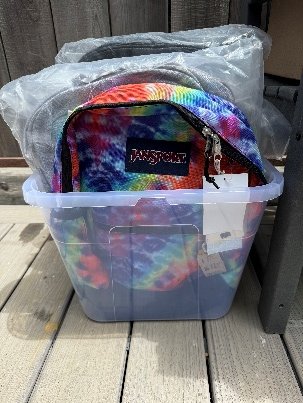
This year, PRC’s Back-to-School program provided backpacks to K–2 students and gift cards for school supplies to K–12 students in Pacifica. Thanks to community support, 171 students from 101 families headed back to the classroom prepared and ready to learn.
How You Can Help
This month, PRC is especially in need of travel-sized:
- Toothpaste
- Toothbrushes
- Hand sanitizer
- Deodorant (men’s and women’s)
All donated items must be unused and within their “best if used by” date.
Contact
Pacifica Resource Center, 1809 Palmetto Avenue, Pacifica, CA 94044 · info@pacresourcecenter.org
PCT Celebrates 50 Years
By Martin Anaya
Amplifying Coastside Voices: PCT Celebrates 50 Years of Public, Educational, and Government (PEG) Access Television

For half a century, community media has served as the digital town square, cultural archive and democratic backbone of local communities. Across the United States, Public, Educational, and Government (PEG) access television empowers ordinary citizens to become creators, preserves local history, and ensures transparent governance. As PCT marks its 50th anniversary as the longest-running PEG center in the nation, there is no clearer example of this vital public service and its profound impact on the San Mateo Coastside.
From Pacifica all the way to Montara, Moss Beach, El Granada, Princeton, Half Moon Bay, La Honda and—YES—even Pescadero, the unique, rural and geographically isolated nature of the Coastside makes hyper-local media not just a luxury, but an absolute necessity. At the heart of this mission stands Pacific Coast TV (PCT), ensuring that the diverse voices of the Coastside are amplified, documented and preserved.
The Power of PEG: Three Pillars of Community Service
PEG television operates on a simple but radical premise: the public airwaves belong to the public. Unlike commercial broadcasting driven by ratings and corporate advertisers, PEG media is driven entirely by community needs. It is built on three distinct pillars:
- Public Access (P): The Ultimate Forum for Free Speech
Public access gives everyday residents, artists, activists and nonprofits the tools, training and airtime to produce their own media. It is media by the people, for the people. Whether showcasing local musicians, profiling neighborhood artisans or airing independently produced documentaries, public access ensures that creative expression is never sidelined by commercial interests. - Educational Access (E): Bridging Classroom and Community
Educational access turns the television screen into an extension of the classroom. It provides a platform for local school districts, community colleges and educational organizations to broadcast student-led news programs, sports games, graduation ceremonies and instructional programming. It also serves as a critical training ground where young people gain hands-on experience in digital storytelling, video editing and broadcast engineering. - Government Access (G): The Foundation of Local Democracy
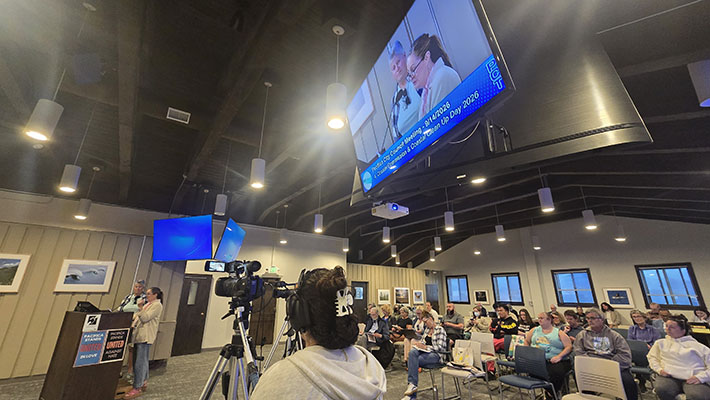
If democracy dies in darkness, government access television is the spotlight. By broadcasting city council meetings, county supervisor hearings and municipal agency workshops, government access provides unparalleled transparency. It allows residents—especially those with mobility challenges or demanding work schedules—to watch their elected officials in action, track local policy decisions, and stay informed on how their tax dollars are spent.
A Lifeline for the San Mateo Coastside
While PEG channels serve a critical role nationwide, their value is magnified exponentially on the San Mateo Coastside. Geographically separated from the rest of San Mateo County by the Santa Cruz Mountains, the Coastside can easily feel isolated from mainstream Bay Area media markets. Major network news stations rarely cover the daily triumphs, local debates or specific infrastructure challenges of unincorporated coastal towns.
Pacific Coast TV bridges this geographic and informational divide. PCT serves as vital connective tissue for the region, broadcasting the proceedings of 13 different municipal agencies alongside local board meetings, nonprofit spotlights, and grassroots cultural events like Fog Fest and the Pumpkin Festival.
When regional issues arise—whether a contentious land-use debate in the Linda Mar Valley, a City Council candidate forum in Half Moon Bay, or an economic shift affecting coastal agriculture and tourism—PCT is there to document it without sensationalism. It provides a fair, measured and hyper-local perspective that commercial news outlets simply cannot replicate.
Furthermore, during seasonal emergencies, coastal storms or highway closures, local community media becomes a critical public safety pipeline, ensuring that accurate, localized information reaches residents when they need it most.
Celebrating 50 Years of the Digital Town Square
As we celebrate the 50th anniversary of community access media, we look back on a legacy of democratizing technology. In its early days, PEG access meant teaching residents how to operate bulky tape decks and heavy analog cameras. Today, in a highly digitized landscape, that mission has evolved into managing sophisticated multi-platform distribution, high-definition digital broadcasting and online streaming archives.
Yet despite rapid changes in technology, the core mission remains unchanged: fostering community connection. PCT continues to prove that even in an era dominated by global streaming giants and algorithmic social media feeds, nothing can replace the value of seeing your own neighborhood, your own school board, and your own neighbors reflected on screen.
Looking to the Future
The 50th anniversary is not just a celebration of what has been achieved; it is a call to action to protect the future of public media. Securing stable funding through cable franchise and PEG fees remains essential to maintaining the infrastructure, staff and equipment required to keep the Coastside connected.
As Pacific Coast TV continues its longstanding mission, its value to the unincorporated Coastside and its surrounding municipalities remains immeasurable. Here’s to 50 years of keeping our community informed, engaged and inspired—and to many more decades of giving the San Mateo Coastside a voice of its own.
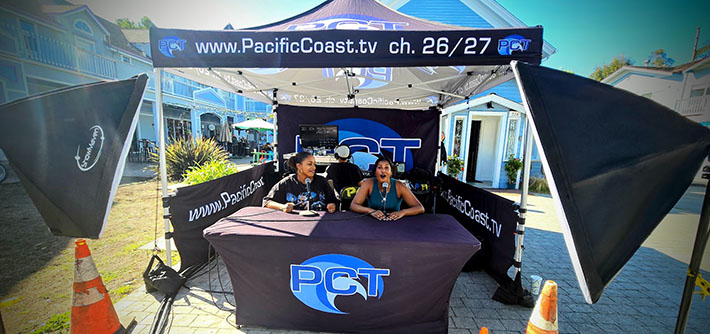
If you’d like to donate or get involved with PCT, reach us at 650.355.8000 or online worldwide at www.PacificCoast.tv.
Pacific Coast TV | 650.355.8001
Comcast ch. 26 Pacifica | ch. 27 Coastal San Mateo County
Streaming worldwide at www.PacificCoast.tv
Pacifica Community Television Inc.
Pacificans Care Highlights
Pacificans Care continues to support community projects that raise funds for the efforts of Pacifica’s core social service agencies—Pacifica Senior Services, Pacifica Child Care Services, Pacifica Resource Center and Pacifica Youth Service Bureau—and the children, youth, seniors and families who need access to the important services they provide. We are committed to building a stronger, more resilient Pacifica community.
Pacificans Care Awards Annual Grants
Thanks to the incredible generosity of Pacificans Care supporters, the Pacificans Care Board presented annual grants to continue the amazing services our four core agencies provide for those in need in Pacifica. Here is a recap of the grants:
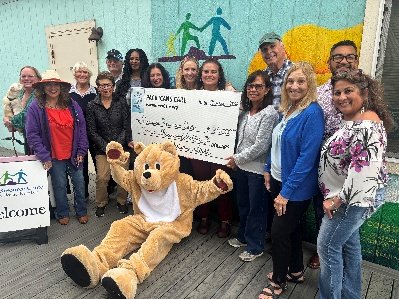
Pacifica Resource Center: $40,000 to continue services to 1 in 5 Pacifica families and individuals needing economic security services such as groceries from the pantry, clothing, emergency financial assistance for rent and mortgage, emergency utility payments, and services for the unhoused. PRC expects to provide over 15,000 services to over 1,500 unduplicated households, including 500 new households.
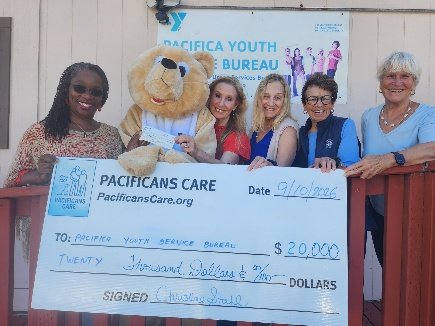
Pacifica Youth Service Bureau: $20,000 to strengthen the community behavioral health system by supporting services at the Pacifica clinic and the Bureau’s renewed partnership with Ingrid B. Lacy Middle School. San Mateo County data indicate that one in three adolescents report needing mental health support each year, while only a fraction receive treatment. Sixty-five Pacificans received behavioral health services, with 530 service encounters at the Pacifica Clinic. Twenty-three students received school-based mental health services at IBL through 62 sessions.
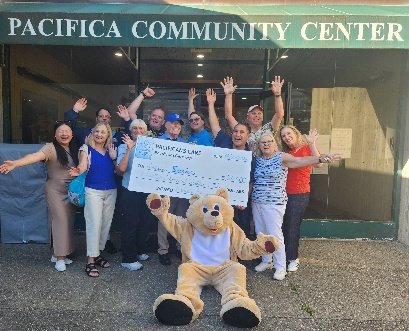
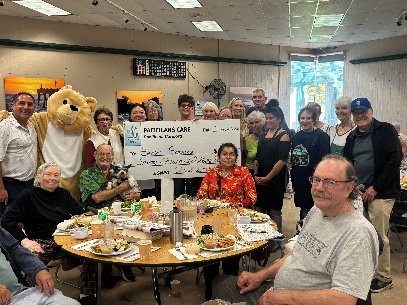
Pacifica Senior Services: $30,000 to provide programs and services that help older adults stay active, connected and engaged. The grant will expand social and recreation opportunities, with a focus on increasing outdoor activities, encouraging intergenerational engagement, and creating an even more welcoming and inclusive community for the more than 700 older adults participating in Pacifica Senior Services programs.
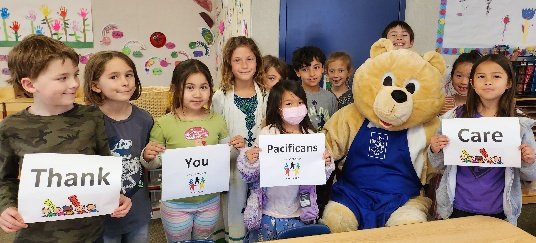
Pacifica Child Care Services: $30,000 gives both preschool and school-age participants the opportunity to take part in large-group field trips designed to expose children to new environments, communities and learning experiences. These outings encourage curiosity, strengthen observation and critical-thinking skills, and foster a lifelong love of learning through hands-on exploration.
Mark Your Calendars
The Rockaway Ricky Memorial Fund 2027 Calendar Release Party is scheduled for Wednesday, October 21, from 5:00 to 7:00 PM at Rockaway Beach Brewery. Come join the fun and pick up your 2027 calendar.
Help Pacificans Care Make a Difference
Pacificans Care is the only Pacifica nonprofit organization solely dedicated to supporting social services in Pacifica, from children and youth to families and seniors. Pacificans Care is an all-volunteer organization administered by an active Board of Directors made up of community members dedicated to making a difference in our community.
Your contributions to Pacificans Care help build a healthy, self-sufficient and improved quality of life for those in need in Pacifica. Thank you for your continuing generosity.
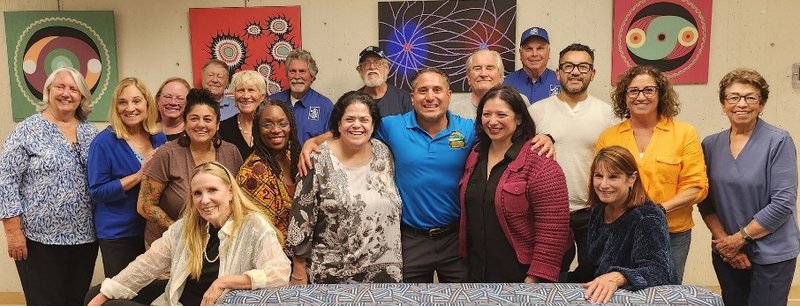
Officers: Christine Stahl, President · Evelyn Taverna, Vice President · Piper Hanson, Corresponding Secretary · Janine Galligani-Ray, Recording Secretary · Jerry Ward, Treasurer
Directors: Bruce Banco, Jennifer Barnette, Alice Bull, Karen Ervin, Horace Hinshaw, Ginny Jaquith, Xenia Gholli, Bill Meyerhoff, Bill Michaelis, Gina Miglio, Nancy Munroe, Mauricio Rodriquez, Jeanne Salisbury, Barbara Wolf
For more information, visit PacificansCare.org, find us at Facebook.com/PacificansCare, or email pacificanscare1982@gmail.com.
P.O. Box 875, Pacifica, California 94044
Pacificans Care is a 501(c)(3) nonprofit organization. Federal tax ID #77-0004308.
Mildred B Owen Concert Hall
October through December 2026

For more info and to buy tickets CLICK HERE pacificaperformances.org
- Oct 3: Pacifica’s own Dave Crimmen Band
- Oct 10: Masha Campagne sings and writes Brazilian tunes
- Oct 17: Ol’ Man Brothers Band (Allman Brothers tribute band). They brought down the house at their debut last year!
- Oct 24: Mike Lipskin plays authentic stride piano, joined by Don Neely on clarinet and Dinah Lee on vocals
- Oct 31: CLOSED
- Nov 7: Tom Rigney & Flambeau have played The Hall for many years. Smokin’ Cajun, country, blues and jazz led by fiddler Rigney.
- Nov 14: Mojazz, a Community Event. All tickets $15. We call Mojazz our House Band.
- Nov 21: My Blue Soul, a 9-piece rockin’ soul band! They’ll be recording a live album that night. Come and be a part of it.
- Nov 28: Sing The Beatles. A full band plays while we all sing along, with lyrics displayed on a screen. (Thanksgiving Saturday)
- Dec 5: Skyline College Jazz Bands, another Community Event! Big band and smaller combos. All tickets $15.
- Dec 12: A Hall-iday Holiday with Meg Mackay & Billy Philadelphia, plus many featured guest performers. An annual tradition!
Pacifica Performances is in the old Sanchez Elementary School, now the Pacifica Center for the Arts at 1220 Linda Mar Blvd. We perform in the Mildred Owen Concert Hall or what we call “The Hall.” All tickets are $25.00 general, $20 for members.
HOPE: Healing, Overdose Prevention and Education
By Susanne Hoff
The Third Annual HOPE Walk and Resource Fair, held on August 29, 2026, at Vallemar Elementary School, was a success. It drew a great turnout of resource tables, speakers and community members, as well as an interactive exhibit called “Hidden in Plain Sight,” a mock bedroom showing the places where drugs could be hidden in someone’s room.
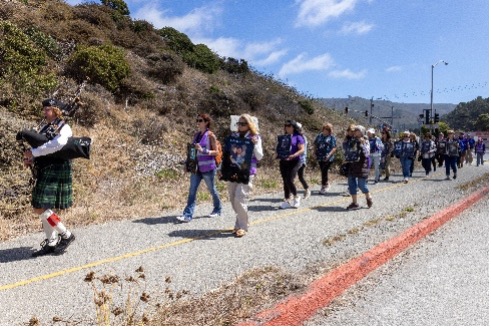
It was an impactful event: we remembered those lost to an overdose, provided community resources, gave Narcan training, and shared our memorial walk. The walk started at Vallemar School and concluded at the Vallemar Gardens, with community members and loved ones carrying angel posters of those lost to overdose.
This somber, impactful walk, led by a bagpiper, helped others visualize the many lives lost to overdose, specifically fentanyl. We released over 100 butterflies in the gardens, symbols of hope, peace and transformation. It was a beautiful day!
Although the number of overdose deaths is decreasing, our work is far from done.
HOPE participated in the 2026 Pacific Coast Fog Fest Parade. Each year, HOPE walks with families and loved ones who have lost someone to an overdose. HOPE provides a memorial poster, free of charge, to carry during HOPE events. To order one, visit the HOPE website and fill out the Angel Poster Order Form. Carrying an angel poster sends a powerful message about the tragic loss families have endured.
The HOPE booth at Fog Fest provided resources, information and education, and we dispensed 500 doses of Narcan at the fair. See below for information on Narcan and how to respond to an overdose.
In partnership with San Mateo County Behavioral Health and Recovery Services and Youth Point Health, HOPE is offering a 6-week Grief Support Group focused on navigating the loss of a loved one to an overdose. The group provides a safe, supportive space to share feelings and learn healthy coping skills. The current group began on September 29. To join the next group, contact mpamatian@smcgov.org. The group is for adults 18 and over, and enrollment is limited. Please share this information with anyone who may be grieving the loss of a loved one to overdose.
HOPE has Narcan dispenser sites throughout San Mateo County. Narcan (naloxone) is a life-saving medication used to reverse an opioid overdose, including overdoses related to heroin, fentanyl or prescription opioid medications. It is most commonly given as a nasal spray. Naloxone is safe and easy to use, works almost immediately, and is not addictive. It has very few negative effects, and has no effect if opioids are not in a person’s system.
How to Recognize an Opioid Overdose
Recognizing the signs of an overdose can save a life. Signs of an opioid overdose may include:
- Small, constricted “pinpoint” pupils
- Falling asleep or losing consciousness
- Slow, weak or no breathing
- Choking or gurgling sounds
- Limp body
- Cold and/or clammy skin
- Discolored skin (especially lips and nails)
How to Respond to an Opioid Overdose
It may be hard to tell if someone is experiencing an opioid overdose. If you are not sure, treat it like one: you could save a life. With a fentanyl overdose, two or more doses of naloxone may be needed. Start by giving one dose and wait 2–3 minutes to see if normal breathing returns before giving a second dose. More than one dose may not be necessary.
- Give naloxone and call 911.
- If needed, give a second dose of naloxone (using a new container) after 2–3 minutes.
- Keep the person awake and breathing.
- If the person is not breathing, perform rescue breathing or CPR.
- Lay the person on their side to prevent choking.
- Stay with the person until 911 responders arrive.
For a complete list of HOPE Narcan dispensers, visit Narcan Locations. HOPE provides Narcan free of charge at events and at the locations listed on our website. Please check business hours before visiting.
A HUGE thank you to all of our amazing volunteers, who go above and beyond to make HOPE events a success. We appreciate YOU! If you would like to volunteer, please visit Volunteer for HOPE.
Upcoming HOPE Events
February 12, 2027: Hearts 4 HOPE Fundraiser Gala
Please check our website frequently for updates on upcoming events.
Pacifica Library Events

Paint an Indigenous traditional dancer on canvas! The Mexika dancer was photographed by the artist in the San Francisco Bay Area, Elizabeth Jiménez Montelongo, who will guide participants step-by-step to paint the image. Adults (19+)

Wed June 10, 24.
Learn how to play the fantasy card game Magic the Gathering! You will have the chance to sort cards, build a deck, and play a match. The best part? You get to keep the deck you build! Children (6-11) Teens (12-18)
Celebrate Diwali with the art of henna! Local artist Swati will apply a beautiful henna design on your hand. Please note that henna paste is a natural product that temporarily stains the skin and could cause allergic reactions in some individuals. Children (6-11), Preschoolers (0-5), Teens (12-18)
Compete, win prizes, and enjoy Sharp Park Library’s gaming consoles! Test your skills against fellow library-goers in tournaments hosted by the library. Our rotating game selection includes FC 25, Super Smash Bros., Mario Kart 8 and more. Held on a select Sunday each month. Ages 10 and up.

Join the Walk and Talk Book Club! We meet the 3rd Tuesday of the month (except for December). We meet at Sanchez Library at 9:30 AM and walk to San Pedro Valley Park and discuss the book while walking the flat Weiler Ranch Trail. This month, we will read There Are Rivers in the Sky by Elif Shafak. Check out our full list of books here.

Build your own mini altar to celebrate Day of the Dead! Local artist Elizabeth Jiménez Montelongo will guide you through the process, demonstrating each step. She will also share information on basic altar elements and the tradition’s Indigenous roots. There is an opportunity for creative liberty and personalization of this project. Materials: Please bring your choice of three empty boxes in various sizes: cereal boxes, shoe boxes, tissue boxes, snack boxes. Other materials will be provided. Feel free to bring small decorative objects, natural objects, and/or a photo or focal item for the top. Adults (55+)
Join award-winning high school robotics group Team 5940 BREAD as they demonstrate the foundations of robotics and circuitry. This hands-on program lets participants code robots and learn the science of circuits. Limited to the first 15 participants. Children (6-11) Teens (12-18) Online registration required.
Have you served in the military or know someone who has? Stop by the library to meet with the County Veterans Services Office. Their staff provide consultations, referrals, and information on general issues and benefits. Get help navigating the VA system and make appointments to file claims. No appointment needed.
Design a fall-themed suncatcher out of leaves and contact paper. For children and their families. No registration required.
Stop by our monthly craft hour and paint your own fork-painted giving tree and landscape! A drop-in program for children and families. Materials provided first come, first served, while supplies last. No registration required. Children (6-11)
You are invited to dance and sing with Cascada de Flores on a musical journey sharing Día de Muertos traditions from Mexico and Central America, as well as our imaginations. This bilingual, participatory performance explores the Day of the Dead (el Día de los Muertos) with song, dance, tradition, personal stories and a wide variety of musical instruments. Together, we will send messages to our muertitos on barriletes (kites), learn about calaveras (sugar skulls), and build an ofrenda (altar) with music, dance and memories. Children (6-11), Preschoolers (0-5)
Join us for an interactive storytime with Nidhi Chanani in celebration of Diwali! Nidhi will share her path to becoming an artist and author. Draw along with her during a drawing demo, followed by Q&A. For children and families.

Nidhi Chanani has written and illustrated several picture books, including What Will My Story Be? and Quiet Karima. The picture books she’s illustrated include I Will Be Fierce!, Binny’s Diwali, and Strong, which won the ALA Stonewall Honor. Born in Calcutta, raised in Southern California, and now creating in the San Francisco Bay Area, Nidhi is an active and engaged storyteller.
Recurring Programs
Bring your bouncing baby to our weekly playtime, full of nursery rhymes and songs you can do together to stimulate your baby’s development. Ideal for newborns up to 18 months old, but all are welcome. After Storytime join us for Stay and Play, a time to engage in open-ended exploration and learning in the company of other children and caregivers.
Learn to create something new with the creative software available through our libraries, share projects you’ve been working on, and get advice. In this session, you’ll explore the basics of Blender: 3D scene navigation, object transformation and mesh editing. Basic computer skills required. Ages 18 and older. Feel free to bring your own laptop and equipment
Get ready to learn and play with your little one! We have songs, wiggles and stories that are all developmentally appropriate for toddlers ages 18 months to 3 years old. Come play with us! After Storytime join us for Stay and Play, a time to engage in open-ended exploration and learning in the company of other children and caregivers.
Get ready to learn and play with your little one! Hear new stories, sing songs and learn wiggles that the whole family can enjoy together, from toddlers to grown-ups. After Storytime join us for Stay and Play, a time to engage in open-ended exploration and learning in the company of other children and caregivers.
Let’s make music together! Join us for a silly, funny, song-and-dance-filled storytime for all ages. After Storytime join us for Stay and Play, a time to engage in open-ended exploration and learning in the company of other children and caregivers.
This event will be held outdoors at San Pedro Valley Park (600 Oddstad Boulevard, Pacifica). Please bring your blanket/seating and sun protection. Storytime may be canceled in the event of inclement weather or poor air quality.
Gotta catch ’em all! Come hang out with other Pokémon enthusiasts at Pokémon Club. Learn how to play the Pokémon Trading Card Game, challenge your friends to a showdown, and try your hand at Pokémon origami!
One-on-one and small-group help with real-life tech tasks. Learn what you need, at your pace. Whether you’re puzzled about sending email attachments or navigating your new smartphone, stop by the Sharp Park Library to connect with our tech-savvy staff for personalized assistance. No registration necessary.
Challenge yourself to a Dungeons & Dragons one-shot! For new players and old. This one-shot is intended for middle and high school students. Handbooks and dice are provided; bring a character sheet or use one of our premade sheets. Teens (12-18)
Do you have a reluctant reader? Sign your child up to have their own session to practice reading with a therapy dog at the library. Registration is required and space is limited, so register early for your 10-minute slot at smcl.org/pawsfortales. Children (6-11 years old)

oin the Walk and Talk Book Club! We meet at Sanchez Library at 9:30 AM, then walk to San Pedro Valley Park and discuss the book along the flat Weiler Ranch Trail (just over 2 miles). This month, we will read The Lion Women of Tehran by Marjan Kamali.
3pm-4pm: Writing Exercise & Co-Writing
4pm-5pm: Sharing & Feedback
Working on a writing project and craving support and structure to finish? Dreaming of starting a poem, memoir, play or novel but unsure where to start? Join Pacifica Sharp Park’s drop-in creative writing sessions! No matter where you are in your writing journey, you’re invited to write in a support environment, connect with other writers, practice new techniques & receive constructive feedback
Need some volunteer hours but don’t have a lot of time to commit? High school students can drop in to help with tasks such as program prep, displays and research. It’s a fun and easy way to make a difference in your community while hanging out with your friends. We’ll vouch for your time spent!
Coastside United for Action / Coastside Indivisible

Join us for our in-person general meetings at the Little Brown Church (1850 Francisco Blvd, Pacifica). A Zoom option is also available.
Tuesday, October 20, 6:30–8:00 PM
This month: Making Sense of Your November Ballot: A Ballot-Help Workshop, a presentation on keeping our cool when political conversations get emotionally charged, plus a discussion of our local “rapid response plans” for whatever happens after the election.
Tuesday, November 17, 6:30–8:00 PM
General meeting at the Little Brown Church. Zoom option available.
October 17 No Kings: Vote Early
October 17 is a day of nonpartisan voter participation. We are bringing our community together to make a plan to vote early, and to make sure every eligible voter understands their options for how to vote and has the opportunity to make their voice heard. Vote early, or join us and make a plan to vote!
Pacifica: 12:00–1:30 PM
Hwy 1 & the Moose Lodge. Meet at the entry to Mori Point. In addition to signs promoting voting, Refuse Fascism signs will be available to remind us why we are voting! Get your Refuse Fascism signs at the northwest corner of Hwy 1 and Reina Del Mar, and gather along the roadway north of the stoplight. Register for this event.
Half Moon Bay: 10:30 AM–Noon
Hwy 1 and Miramontes Point Road. It’s Pumpkin Festival weekend: come to the rally, then enjoy the festival afterwards. Register for this event.
San Francisco: 11:00 AM–12:30 PM
Human Banner, “No Kings: Vote Early!” at Ocean Beach Stairwell 17, 1000 Great Hwy, San Francisco. Register for this event.
Colma: 2:00–3:30 PM
Corners of Serramonte Blvd and Junipero Serra. We will have extra signs and look forward to celebrating voting with you. Register for this event.
Bring a Sign
Register or just come, and bring a friend! Bring Vote Early signs or props, or other nonpartisan signs promoting voting. Some ideas:
- Your Vote = Your Voice!
- Speak Up. Vote!
- Make a Plan to Vote!
- Vote Early with Your Friends!
- Get Out the Vote!
- You Have Choices. Vote!
- Prevent Truth Decay. Vote!
- Voting Is an American Right!
- Fair and Free Elections
- Check Your Registration
- Vote Early
Find all California events at mobilize.us/nokings.
Pacifica Historical Society 50 Years

Celebrate the 50th Birthday of the Pacifica Historical Society
Sunday November 8th at 2 PM
Pacifica Coastside Museum 1850 Francisco Blvd. Pacifica
See a new display that briefly summarizes the History of the Pacifica Historical Society.
Help us dedicate a tree in honor of Shirlee Gibbs, a long time PHS member and indomitable volunteer.
Learn about the history of the Little Brown Church building and its many uses over more than 115 years.
Enjoy a Birthday Cake from Mazzetti’s Bakery.